
Brothers Among Brothers in Friendship with Christ
By Praedicare Staff
For those called to be Dominican Friars, friendship with Christ and in Christ takes on a particular meaning: It is shaped especially within community life. The Friars’ common life is fundamental for them in every way–as men, as priests, as preachers for the people of God.
A life lived “completely in common” is what “grounds and enables the life of preaching, and teaching, and celebrating the sacraments, and everything else,” explained Fr. Gabriel Torretta, O.P., an assistant professor of theology at Providence College.
His voice tinged with excitement, Fr. Gabriel searched for a way to adequately express the importance of community life. He recounted how St. Dominic, in the earliest days of the Order, sent the brothers two by two to engage the world, just as Christ did. St. Dominic did this, Fr. Gabriel marveled, when there were only 12 or so brothers to send. Why not wait until he had a more solid group? Greater numbers?
“But then I lived it,” he said, “and I realized…You have one Dominican, and he can do really good work, maybe great work. But you have two Dominicans, and you have a totally different reality. Not twice as much work, or three times as much work–you have weird orders of magnitude…You’re just in a different world.”
He continued: “It’s like you’re in a video game, and you’ve hit some level trip that you didn’t realize existed, and now suddenly the world is 10 times as large, and you have all of these power-ups, and you’re just like, ‘I don’t know what’s happening, because I’m still just doing what I was doing before, but suddenly everything is just completely different.’”
Better together
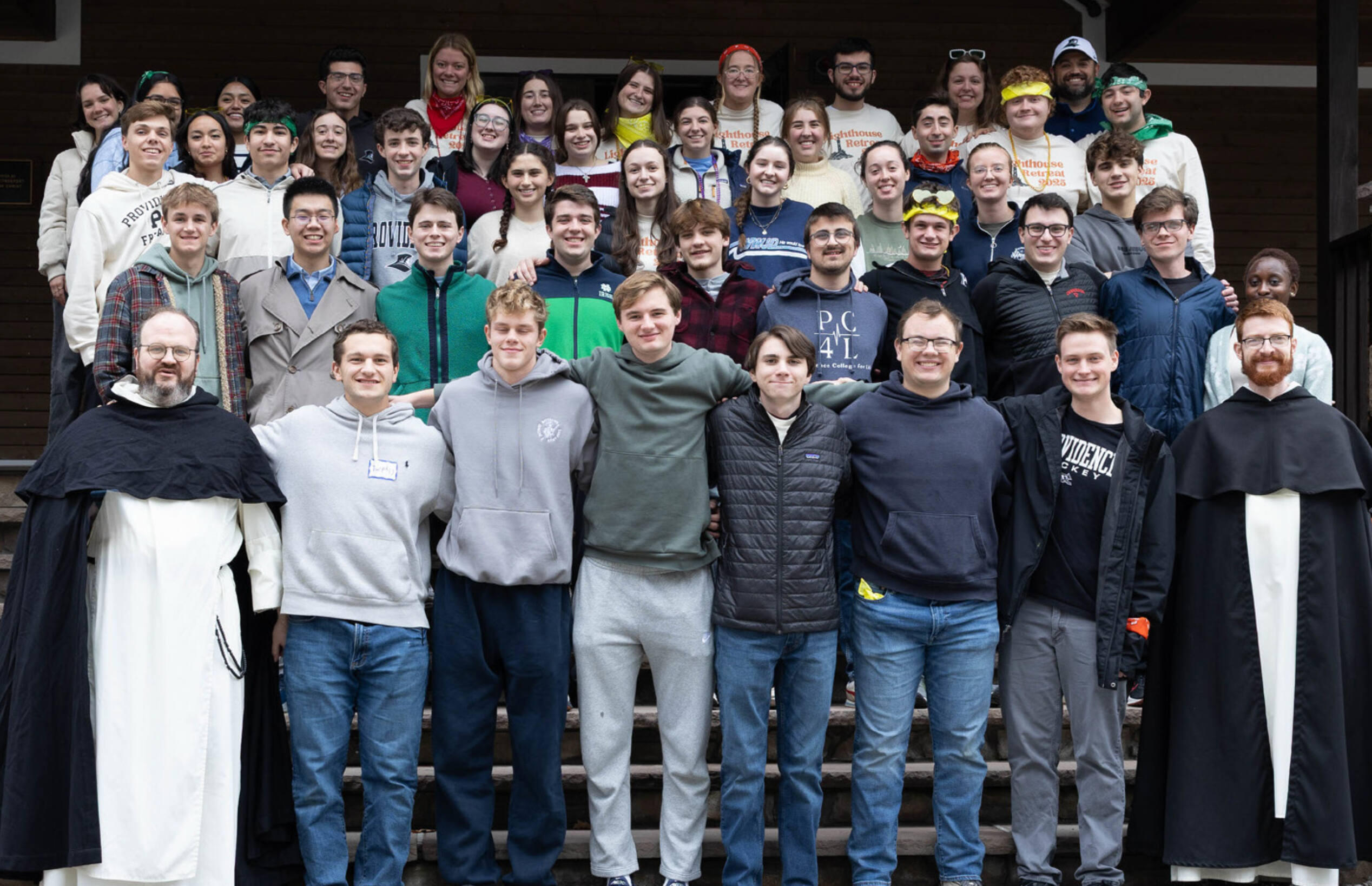
The fruits of the Friars’ ministry at Providence College illustrate the powerful impact of the Dominican community. Both students and staff are discovering the Church with the help of the Friars. This year, there are 70 participants in the OCIA program. Last year, there were more than 50. And five student brothers currently in formation as Dominican Friars graduated from Providence College. Additionally, seminarians for the Diocese of Providence are assigned to study at Providence College, extending the Dominicans’ influence even further.
In addition to being known as theological and philosophical powerhouses, Friars teach in a whole range of departments, including mathematics, economics, and biology–plus serve as chaplains for Providence College’s Campus Ministry and its sports teams. Off campus, they serve as chaplains for Brown University and the Rhode Island School of Design.
This increased fruitfulness happens, in a “really wild way,” according to Fr. Gabriel, because of how the Holy Spirit acts through them. Friars “work infinitely better together than they work separately,” Fr. Gabriel said. It is “something absolutely fundamental to the life of the Order–that Dominic sent them out in pairs, rather than one by one.”
“Living for each other”
The common life requires effort, Fr. Gabriel acknowledged, as each brother finds in his brethren what he finds also in himself: the desire to “do their own thing in various ways.”
Thus the Dominican vocation is an invitation to continually pursue a truly common life, to work against the pull toward egotism, and strive for St. Dominic’s vision. Like the early Church, the Friars must strive to be of “one heart and mind” (Acts 4:32).
“The Dominican cannot be fully alive unless he is drawn out and challenged, and humbled, and smoothed out by the actual…human beings around him,” Fr. Gabriel said.
The married man or woman will see their own life and struggles reflected in the Friars’ community life and its similar challenges. “Shedding a light on the dark places of the heart, and the smoothing out of the roughness of my incessant, constant desire for my own individual will–that’s a recognizable characteristic of marriage, and growth in shared life. And it is emphatically and dramatically found in religious life,” Fr. Gabriel said.
Practicing for heaven
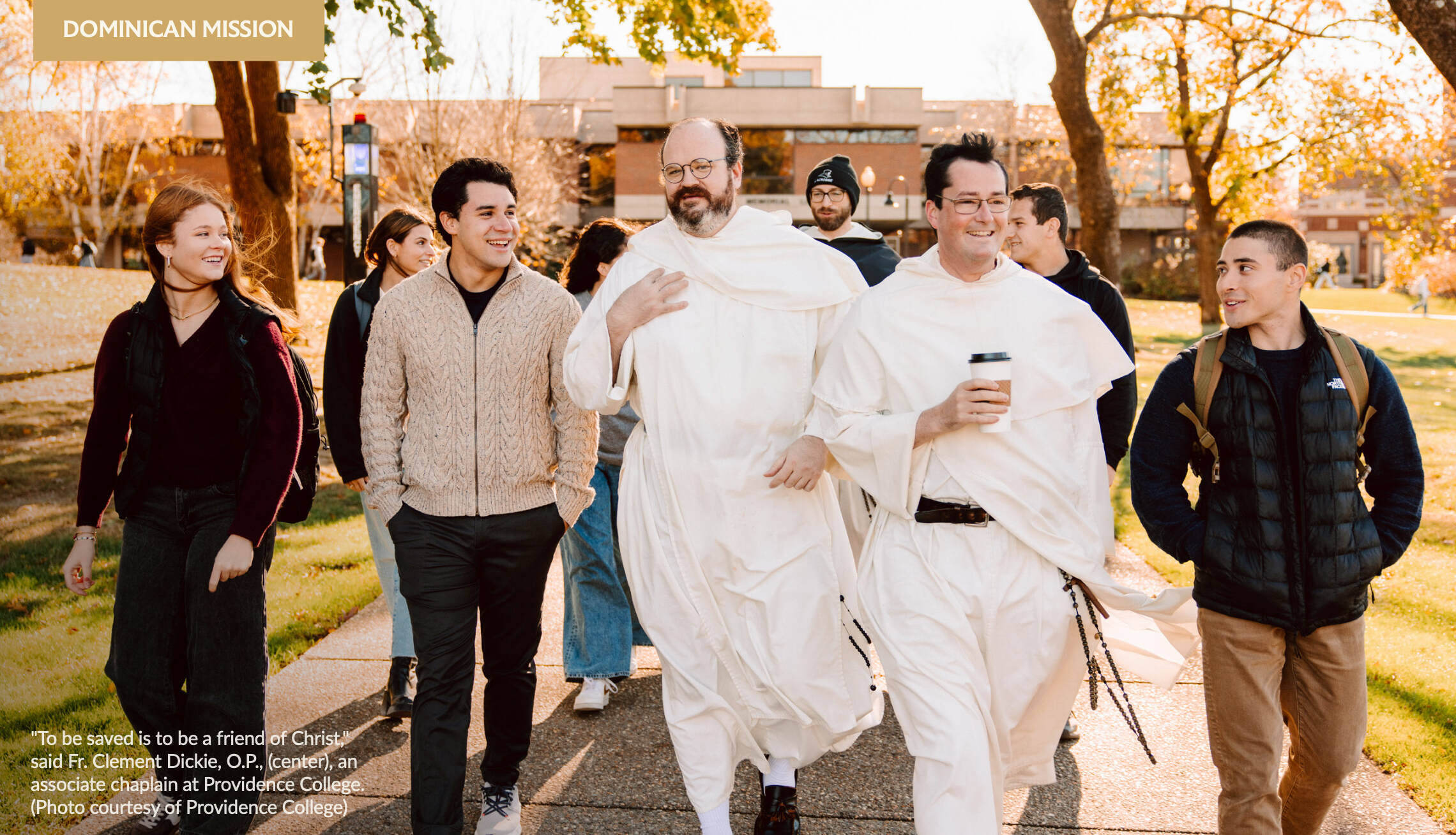
“To be saved is to be a friend of Christ,” explained Fr. Clement Dickie, O.P., an associate chaplain at Providence College. “Charity is…friendship with God,” he said.
As a consequence of this charity, Friars must love other members of the community out of love for God. Living the communal life, then, is “practicing for the life of heaven,” he said. “It’s actually living the life of heaven on Earth.”
“We face a lot of imperfections here on Earth,” he said, “because of the burden of sin.”
Living and thriving in a community is a learning process. For the first year of formation as a friar, a brother is under the instruction of a novice master, and then when he moves on to study philosophy and theology, he reports to a student master. These Friars, called “formators” show him how to live in community.
The novice master or student master “corrects you,” Fr. Clement explained, “if you are creating undue burden for everybody else.”
Thus forged into a group of brethren, the Dominicans become support for each other. And that support extends beyond the walls of the priory, into the halls and streets of their ministries. The core of common life, like the center of a wheel, extends out into the community.
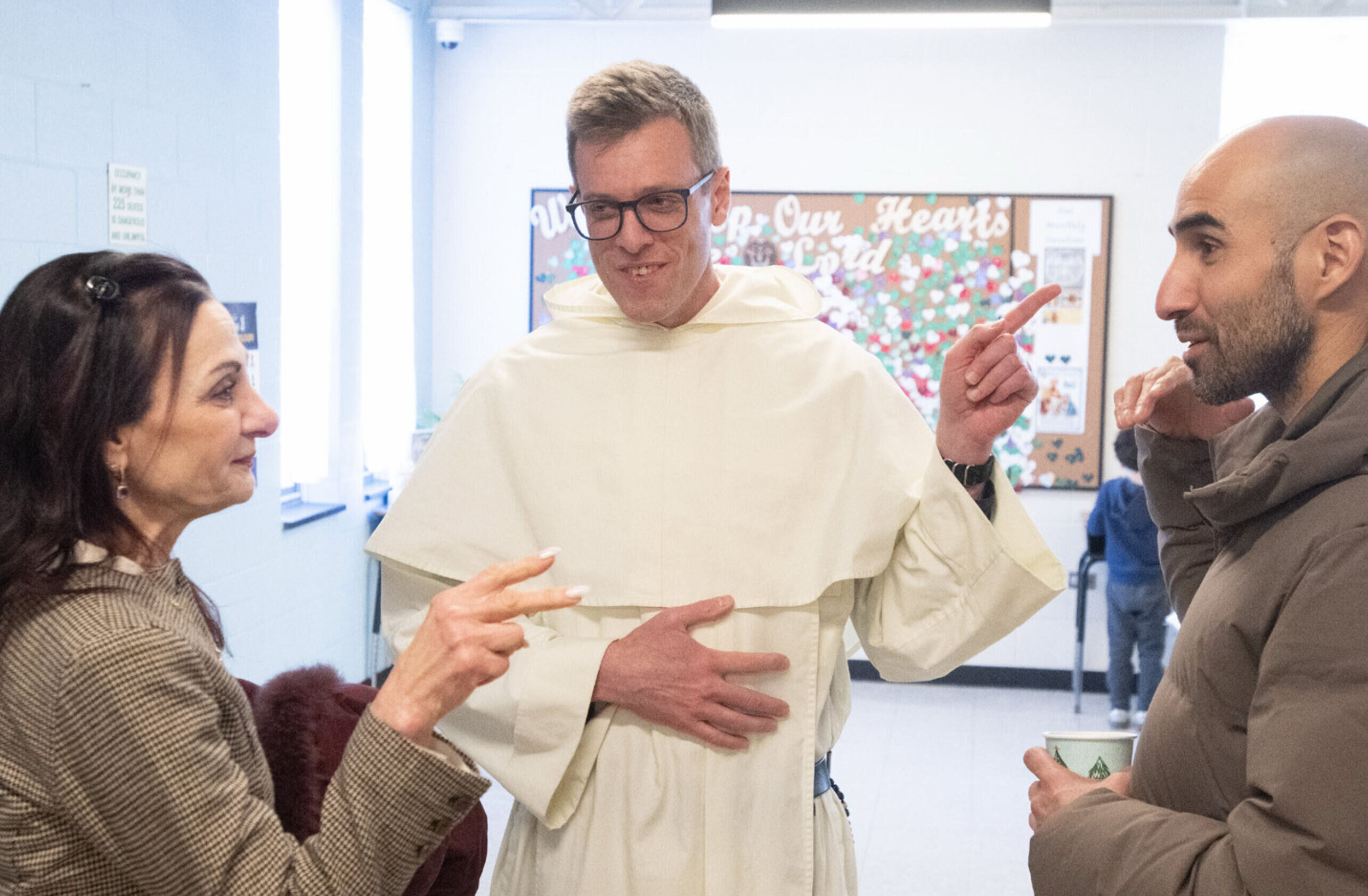
“As Friars, we come together multiple times a day, for prayer and for a shared time together over a meal, in addition to all the other little ways we connect with each other as we’re going about our day,” explained Fr. Luke Hoyt, O.P., who is the pastor of Holy Innocents Parish in Pleasantville, NY. “But those little centers of shared prayer and communion over a meal give us the rootedness from which we’re able to labor in the work of ministry, as well as something to return to.”
In Pleasantville, for example, this extension of Dominican community life into the life of the parish is clearly visible.
The church is currently undergoing renovation to add an Adoration Chapel, and the parish is characterized by a robust sacramental, spiritual, and fraternal life. Their activities include First Friday Adoration, Bible studies, book clubs, potlucks, movie nights, and even ski trips and hikes. The Friars themselves are a visible part of the town, from Memorial Day celebrations to the village block parties and more.
Noted one parishioner: “Because the Friars are so woven into the life of the town, parish life doesn’t feel separate. Seeing them around–after Mass or at town events–often sparks questions from friends and opens the door to deeper conversations about faith.”
The reach of these Friars actually extends far beyond Pleasantville. The Friars have undertaken campus ministry for the colleges in Westchester County, filling an important pastoral void. Also, one of the Friars in the community, Fr. Philip Nolan, O.P., is the editor-in-chief of the magazine and prayer companion Magnificat, which has a monthly English-language circulation of 230,000. Magnificat also has versions in Spanish, German, French and even Lithuanian. This Dominican community in a New York village of fewer than 8,000 people has a truly international reach.
And yet the elements that build up common life are usually ordinary and subtle.
“In addition to the scheduled meals and prayers, there are also the simple everyday interactions,” Fr. Luke said. “In every house I’ve lived in there have been Friars who, in the middle of a busy day, would ask you how you were doing–and you would know they actually cared how you were doing and it wasn’t just a formality.”
“A home to go to”
Each brother is able to share his Dominican life not only with brethren his own age, but those both younger and older. Having the experience of older Friars can be transformative, both in community life and in the apostolate.
“Being multi-generational is a big, big part of the order,” Fr. Luke said, “And, just like it is for a family–a family has grandkids and grandparents, and parents, and everything in between–and so, similarly, we ourselves recognize that that’s a feature of our life, and a valued part of our life.”
While many of the historical accounts of St. Dominic detail particular moments when he was acting alone, something else shines through, Fr. Clement suggested.
“You do get the sense that part of what enabled him, or animated him, to be able to do those things is that he was building something larger than himself, that there was more to it than that–that there was a home to go to.”
And that home is a place of peace and support when the ministry is challenging–not just for advice and a place to “think things out and solve problems.” It’s more than that.
Fr. Clement explained: “The community’s a place that you can go back to–where you’re going to be less bothered by whatever troubles are going on–on campus, or in the parish, in the ministry. There, the life of prayer goes on…There are people who are going to bring you down if you get too high, and bring you up if you get too low.”
Life in community “can help put everything into perspective,” Fr. Clement said.
In the end, friendship with Christ–and through Him, friendship in communal life–is a fundamental part of being a Dominican, being a priest…and being a Christian.
“If that’s not the basis of my whole life as a priest, then I really have nothing,” Fr. Luke reflected. “So that, to me, that’s everything.”
As Fr. Luke describes, the charity a Dominican Friar receives from his friendship with Christ overflows to his brothers and then outward to their shared mission territory. Dominican fraternal life requires constantly striving to live for God and for the community, to be sure, and yet, it is in the shared life that they find both their fruitfulness and their joy.