
Spreading Thomism Far and Wide: The Thomistic Institute Grows to 109 Campuses Worldwide
By Praedicare Staff
Eight hundred years after the birth of St. Thomas Aquinas, O.P., students on college campuses gather each year to celebrate, discuss, and apply his writings. Under the direction and guidance of the Thomistic Institute, these students receive an education and a community with the power to change their lives.
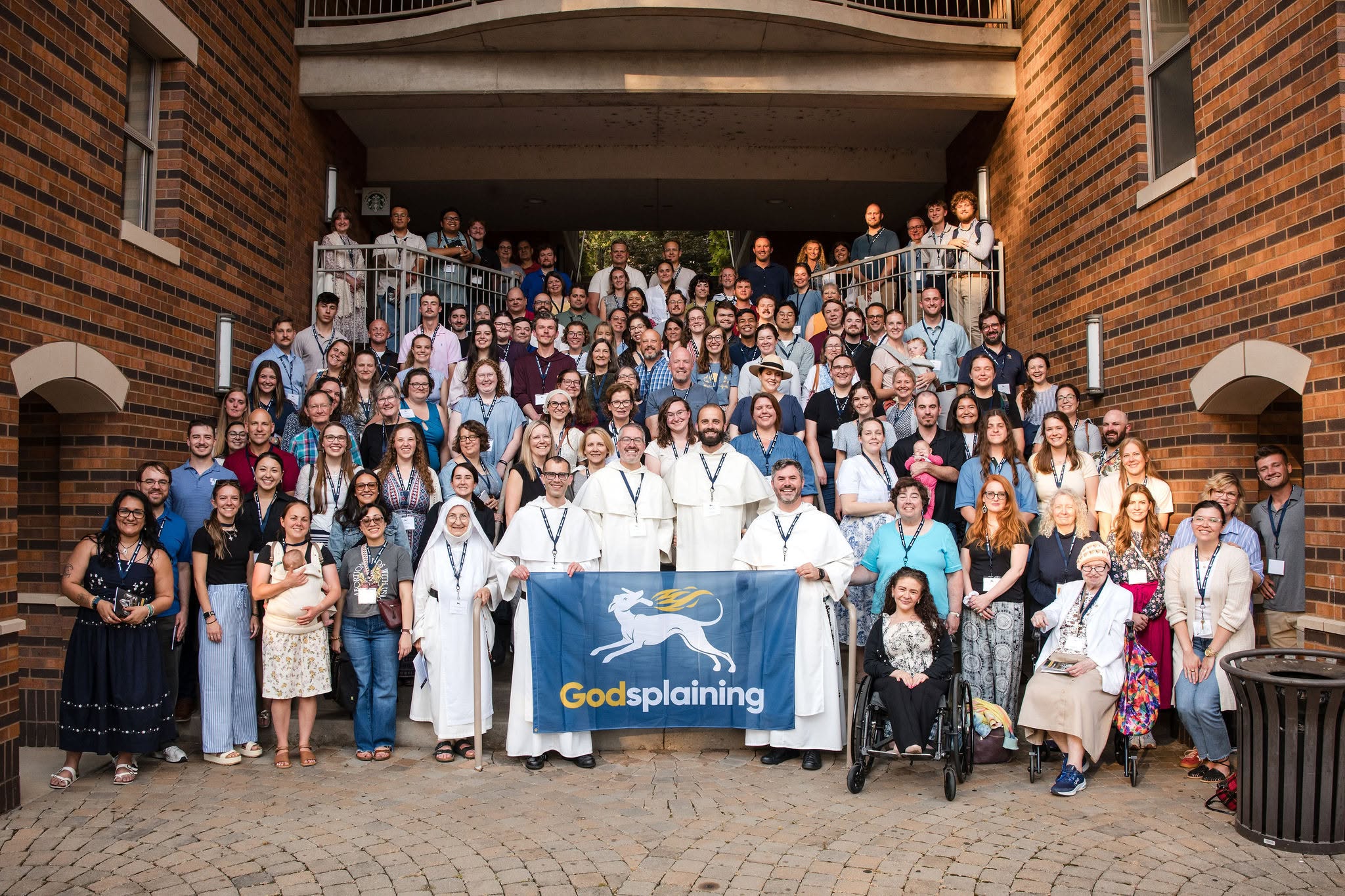
The Thomistic Institute (TI) is an academic institute of the Pontifical Faculty of the Immaculate Conception at the Dominican House of Studies in Washington, D.C. Founded by Fr. Thomas Joseph White, O.P., and Fr. Dominic Legge, O.P., in 2009, the TI has experienced a rapid growth that speaks to the urgent thirst for knowledge and truth in our public intellectual sphere and college communities. The TI’s campus chapter program, which began with two chapters in 2016, now supports 109 universities around the world, with more on the way.
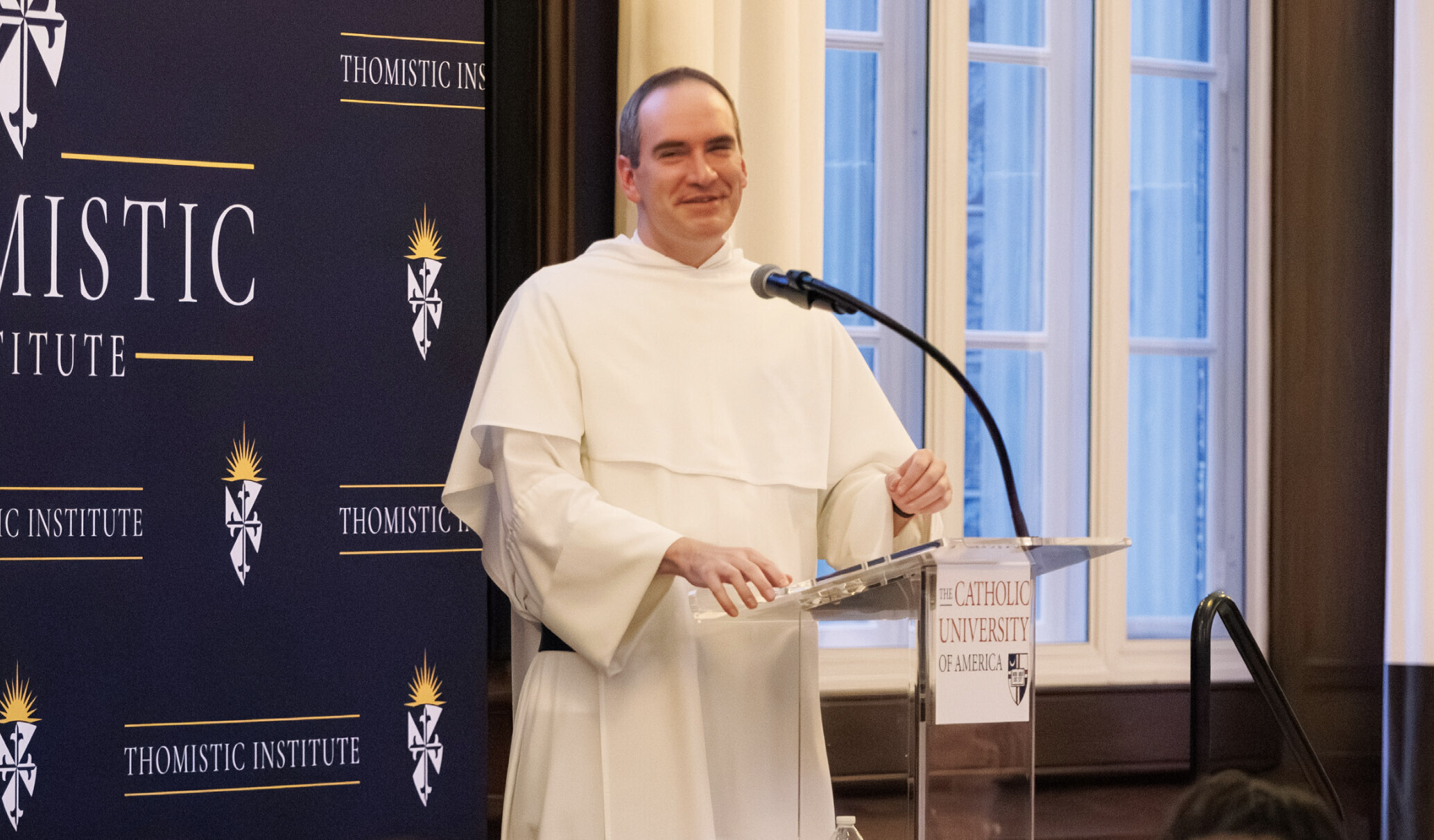
Fr. Ambrose Little, O.P., the current Director of the Thomistic Institute, has a clear-eyed view of the mission: “To bring the Catholic intellectual tradition broadly, and the teachings of St. Thomas Aquinas specifically, to the academy… It’s an important mission in 2026 for the same reason it’s important in every age, that we are seeking to understand the truth and to understand the world as it is.”
Where the Truth is Needed
Fr. Jonah Teller, O.P., a parochial vicar at St. Joseph’s in Manhattan’s Greenwich Village, describes it as “radical conversion to the Catholic faith, seemingly out of nowhere.”
Five years ago, his parish helped about 15 people join or rejoin the Church. This year, it was 87.
The number is about the same for Fr. Joseph Hagan, O.P., a parochial vicar at the University Parish of St. Thomas Aquinas, attached to the University of Virginia, in Charlottesville, Virginia. More than 80 people passed through their program to join or return to the Church this year.
What is drawing them in?
The Thomistic Institute has had an unexpected growth pattern.
“Most of the universities we’re present at are non-Catholic universities,” Fr. Ambrose says. “It’s only by exception, at the invitation of a Catholic university, that we go to them.”
The lectures are approachable for both spiritual seekers and lifelong Catholics.
“The truth itself is attractive,” explains Fr. Ambrose. “Anybody who’s presented with an expression of reality that accurately portrays the way the world is should naturally be attracted to the sorts of things that we’re doing.”
“We don’t have ad campaigns trying to get universities to start chapters,” he says. “It’s all by word of mouth.”
The rapid spread of the Institute is most often through peer-to-peer invitation from college students themselves, who have learned from the TI, and wish to bring its work to their own campuses.
Harvesting
Certainly, the Dominican Friars are trying to be an effective instrument for God’s efforts.
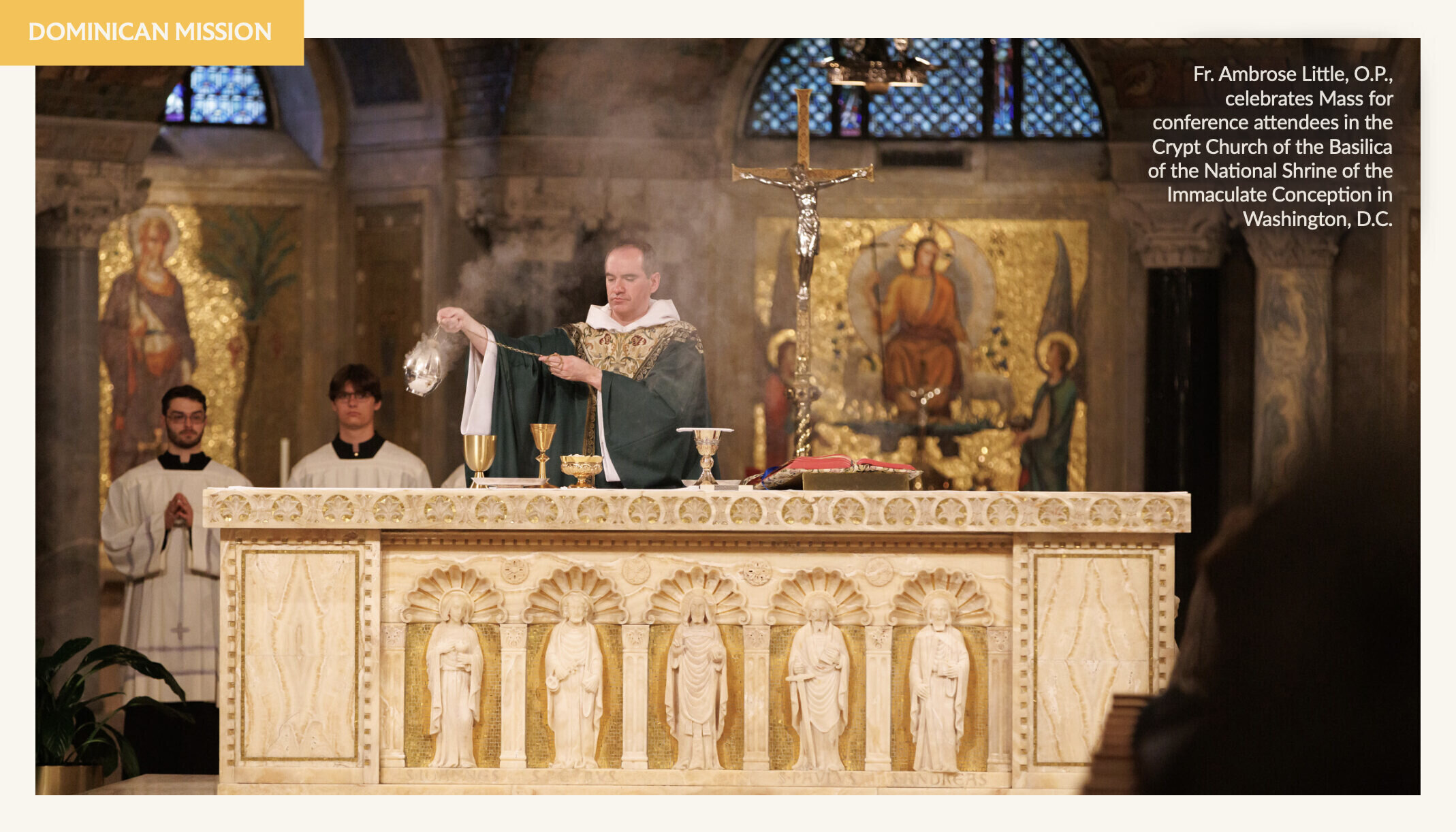
“The will of God is delightfully mysterious. Our job is to harvest what is in front of us. We reap where we did not sow,” Fr. Jonah explained, acknowledging that his Dominican formation has helped him be a tool in the Lord’s hands.
“It makes me so grateful for the formation I received at the Dominican House of Studies; the other friars and I were given a strong, trustworthy, coherent, and wise intellectual formation, steeped in the thought of St. Thomas Aquinas, that we can distill down to our OCIA program in an easy way,” he said.
What Questions Matter?
Why has the Thomistic Institute been so popular with undergraduates?
Fr. Ambrose’s answer involves the moral and intellectual seriousness of the TI above all.
“Students who are serious about their faith, or who have serious questions about the faith, whether they’re faithful or not, recognize an organization and a group of people who are interested in their questions and who really want to answer them,” he says.
The TI is not a debating society, and it is not an advocacy group either. It is also not a substitute for the parish. It is meant for a particular kind of intellectual need, and for a particular kind of student.
A student with difficult questions about God’s existence, the sacraments, or Trinitarian theology will find the lectures given by the Thomistic Institute to be the exact thing that they need. These students, according to Fr. Ambrose, will learn “to approach those questions themselves, becoming students of St. Thomas Aquinas, so that they can learn with him and from him.”
A Dialogue
Fr. Ambrose points to a medieval saying to illustrate the Thomistic Institute’s success: whatever is received is received according to the mode of the receiver.
In practice this means that TI lecturers are encouraged to meet students where they are, that is, as intellectually serious seekers of the truth.
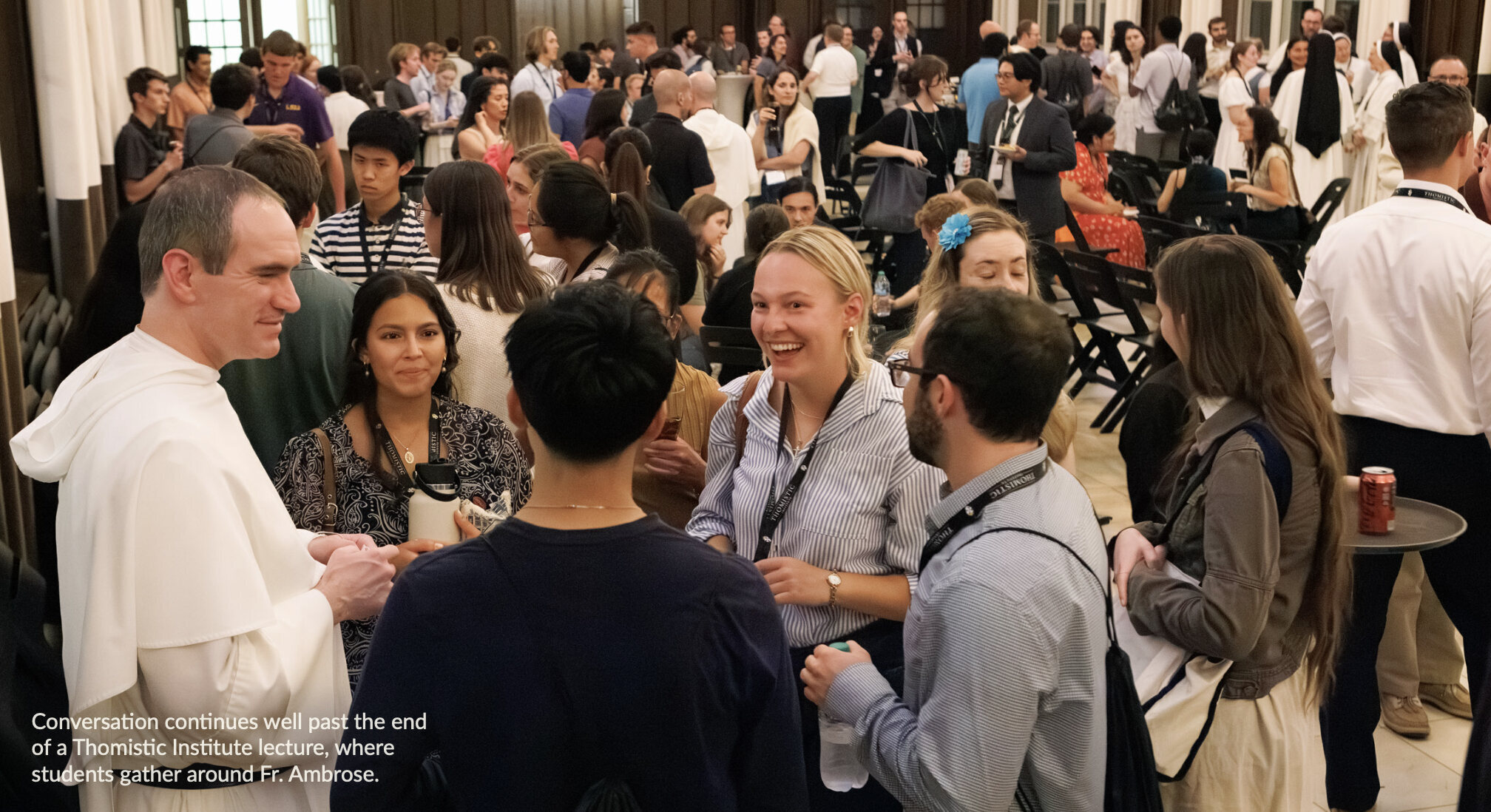
“More often than not, when people first ask a question, it’s not well formulated,” Fr. Ambrose says. “You don’t want this to be, ‘You ask me questions, I give you answers, bada-bing, bada-boom. No. It’s a dialogue. If we can find a way to show respect to people’s deep-seated and important questions, they are always open to the truth when it’s presented to them.”
The goal is to help students make their own questions more incisive. Dialogue helps them arrive at a clearer and more relevant answer, while also respecting the perspective of the person doing the asking.
The Dominican Difference
The Order of Preachers was founded to bring the Word of God to those who had lived without truth, and it has proudly carried a strong intellectual tradition as a part of that vital mission.
The teachings of St. Thomas are a special, generation-by-generation inheritance of the Dominicans.
“He is our brother,” Fr. Ambrose says.
As the Common Doctor of the Church, St. Thomas has been consulted on nearly every important theological and philosophical question raised since the Middle Ages.
This brotherhood is no coincidence. It allows this current generation of Dominican friars to lecture students not only on St. Thomas’s historical writings, but on how to learn his truth-seeking methods, in order to apply them to questions he never would have encountered.
Some questions, such as those surrounding artificial intelligence, particularly deserve an approach grounded in eternal truths. This subject, for instance, comes up constantly on the TI’s college campuses. The response from the Institute has been timely and rigorous: a steady catalogue of lectures on the subject is building, and a forthcoming Aquinas 101 series on the subject will bring answers to a broad audience online.
But of course, the perennial questions that concern college students have gone nowhere: Does God exist? How should I live? How should I discern a vocation? How should I find a spouse?
The Thomistic Institute continues to meet students where they are.
Fruits of the Mission
We asked Fr. Ambrose what graces he has witnessed as the Director of the Thomistic Institute.
“Too often there’s this narrative that if you get too serious with questions about reality, that might take you away from the faith,” he says. “But in fact, students who are really interested in reality, and not afraid to ask big questions, most often deepen their understanding of God and dedicate themselves to Him more fully.”
The evidence that the TI’s approach works is real, and it is visible on college faculty websites. Between ten and fifteen people who attended lectures or conferences early in the Institute’s life are now professors—some are even speakers for the TI now.
“We see those who have received now giving back,” Fr. Ambrose says.
“Even if only ten to twenty percent of your undergraduate population have these deep questions,” he says, “nevertheless, that’s a lot of people.”
Thanks to the work of Fr. Ambrose Little, O.P., and the rest of the Thomistic Institute staff, the thought of St. Thomas Aquinas continues to bear good fruit in the 21st century. When students on 109 campuses go searching this fall, someone will be there to take their questions seriously. We hope that your prayers will support the work of the Thomistic Institute as it continues to expand programs across the United States and the world.