
Welcome Home: Dominican Parishes and Campus Ministries Welcome Record Numbers of New Catholics
By Praedicare Staff
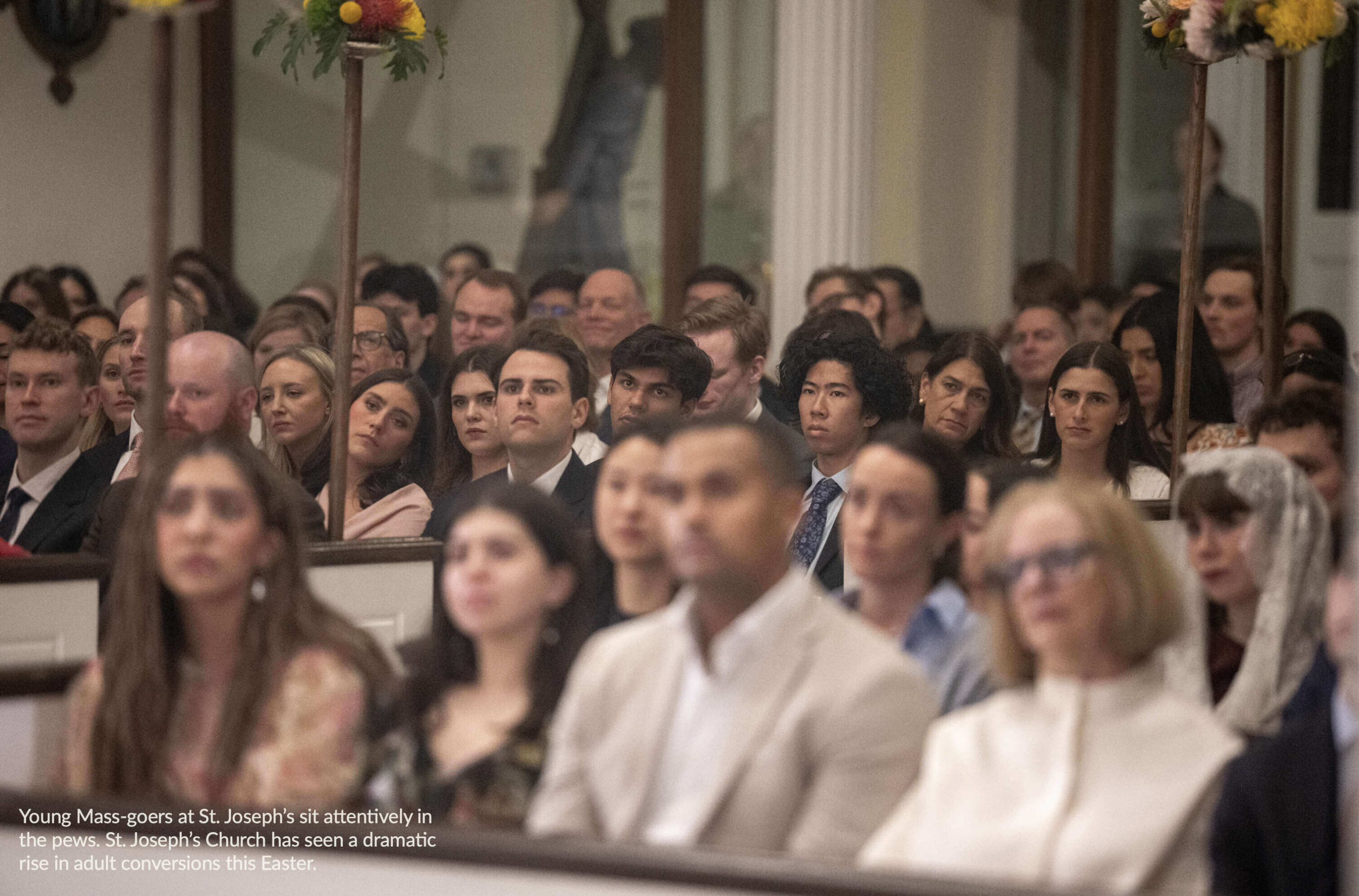
From Virginia to New York, the Dominican friars, as well as the laypeople helping them, are thrilled with it. In some cases, longtime churchgoers now have to show up 30 minutes early to get a seat at Mass!
What is going on?
Fr. Jonah Teller, O.P., a parochial vicar at St. Joseph’s in Manhattan’s Greenwich Village, describes it as “radical conversion to the Catholic faith, seemingly out of nowhere.”
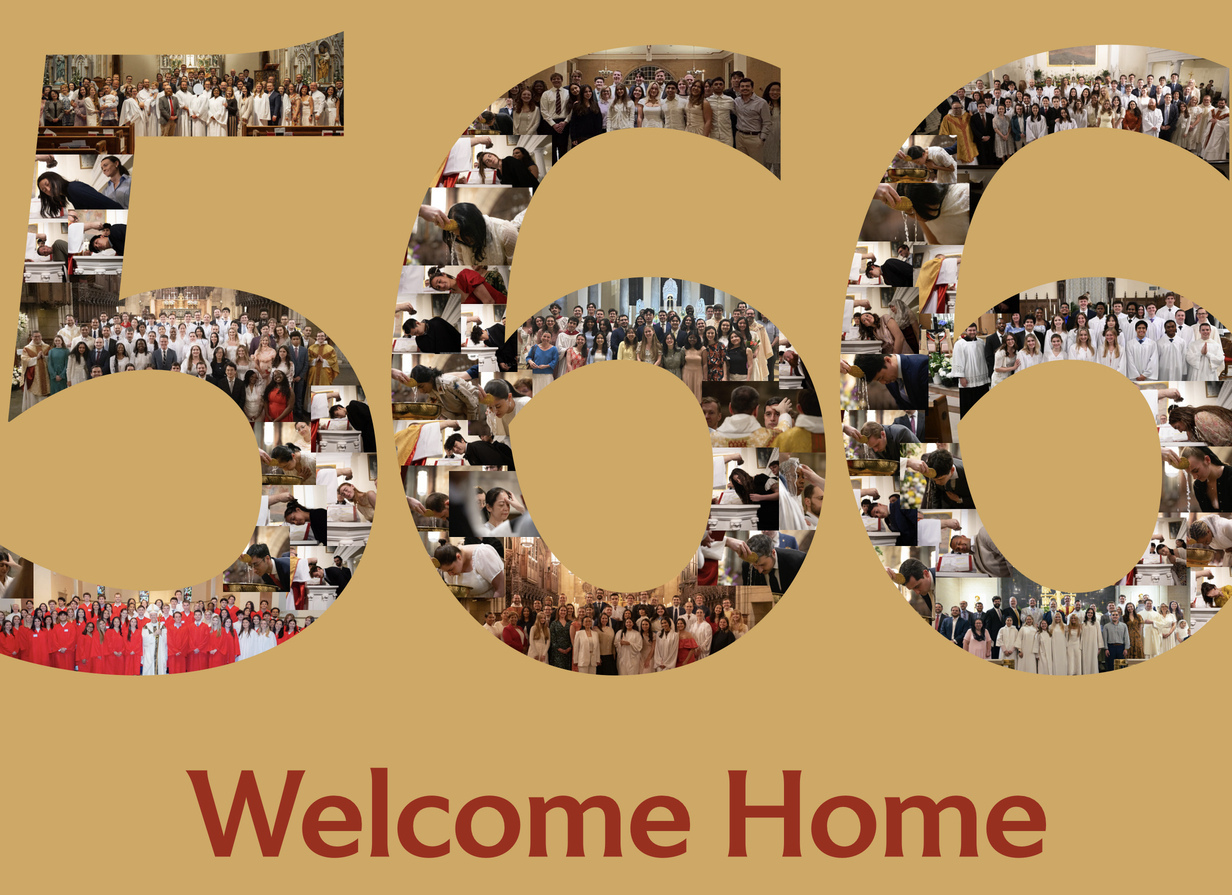
Five years ago, his parish helped about 15 people join or rejoin the Church. This year, it was 87.
The number is about the same for Fr. Joseph Hagan, O.P., a parochial vicar at the University Parish of St. Thomas Aquinas, attached to the University of Virginia, in Charlottesville, Virginia. More than 80 people passed through their program to join or return to the Church this year.
What is drawing them in?
“The Eucharist,” answers Fr. Joseph simply. “That the Eucharist is truly Jesus Christ.”
The friar noted that those who come from the Protestant traditions, or from no faith basis at all, realize that “the experience of going to a Mass, and being physically inside a church with a tabernacle is something that can only be…experienced in a Catholic church.”
He has found that many people have a “sense of skepticism” about any fulfillment that can be found with secular values, but that’s not the reason they are coming to the Church. “When I ask them, they bring up the Eucharist, even though it is nothing new.”
“Other Christian services are often good here, but they are clearly man- made. It is clear that humans put them together: song, preaching, then song. But when you come to Catholic Mass, there is a mysterious, and yet inviting and attractive, strangeness,” he said.
“God is initiating relationships with these people; He is drawing them in,” offered Fr. Jonah, as if nothing further can be said.
Fr. Boniface Endorf, O.P., the pastor of St. Joseph’s in Greenwich Village, also points to the awareness of Christ’s presence as the main draw.
“We want someone who walks into our doors for the first time to think that this is a place where God is present. I hope they want to encounter God here. We have a reverent and beautiful liturgy, and of course we hope the preaching is good too,” he said.
Harvesting
Certainly, the Dominican Friars are trying to be an effective instrument for God’s efforts.
“The will of God is delightfully mysterious. Our job is to harvest what is in front of us. We reap where we did not sow,” Fr. Jonah explained, acknowledging that his Dominican formation has helped him be a tool in the Lord’s hands.
“It makes me so grateful for the formation I received at the Dominican House of Studies; the other friars and I were given a strong, trustworthy, coherent, and wise intellectual formation, steeped in the thought of St. Thomas Aquinas, that we can distill down to our OCIA program in an easy way,” he said.
How does an adult join the Church anyway?
Every adult catechumen journeys through what is known as the Order of Christian Initiation of Adults, or OCIA.
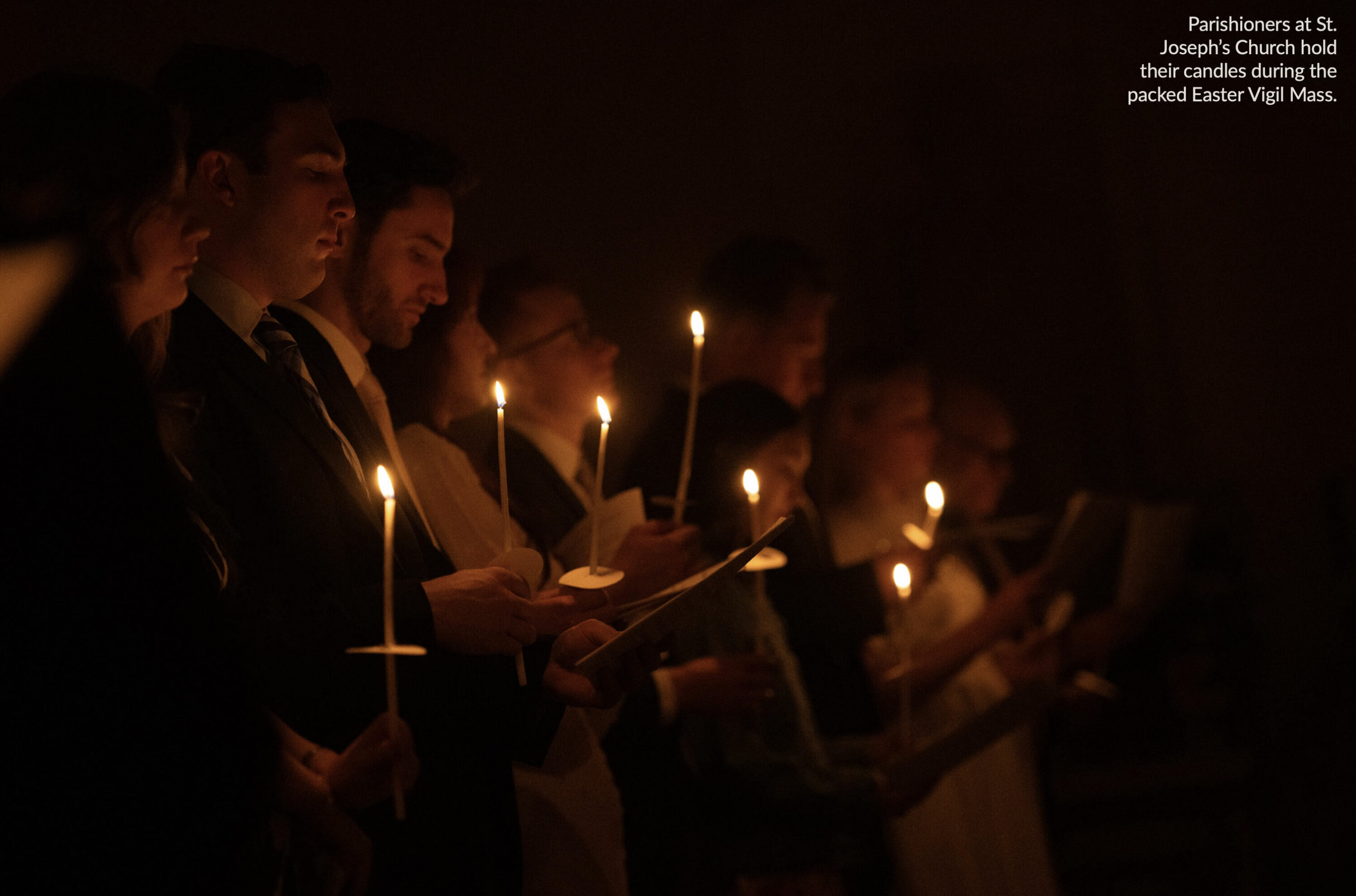
The goal of any OCIA program is for adults to learn about the Catholic faith; that process hopefully culminates in the reception of baptism (for those who haven’t already been validly baptized), confirmation, and the reception of Holy Communion.
The sacraments of initiation are the first window into the life of grace that the Church promises.
We asked our priests to talk about how they explain these three sacraments to those who are about to receive them and become new members of the Church.
Starting with baptism, Fr. Jonah brought up his go-to metaphor:
“Imagine that we’ve got this big bowl of clear water, and this new, dry sponge. When I let the sponge go into the water, the water will infuse the sponge, and that’s what baptism is. You are baptized into Christ Jesus. You are baptized into His death, and into His resurrection—so your soul, your being, is plunged into the mystery of Jesus Christ: that He lives for God, that He was resurrected, all that is given to you, like water is given to the sponge.”
After baptism comes confirmation.
Fr. Joseph offered his explanation for this sacrament: “No one is a benchwarmer in the Catholic Church; everyone has a mission. Our mission is what we’re made for, but it is far beyond our natural capacity. Everyone has a vocation to holiness, and that vocation—whether [lived in] marriage or the priesthood—is going to be challenging. We all have a vocation to love and forgive our enemies, which we know is hard, and fortunately in the sacraments God offers to give us the strength we need.”
Fr. Jonah uses a different image: “Confirmation is the strengthening and maturing of the life of baptism. Compare an infant to a 25-year-old man—there is a big difference.”
Finally the newly confirmed are invited to receive their first Holy Communion.
Fr. Jonah explains the Eucharist by saying, “With the Eucharist, you are what you eat. You are transformed by grace to become what Jesus Christ is by nature. If you don’t eat, you will die. You will get hangry, you will decay.”
Fr. Joseph explained further, “There is a spiritual rebirth in baptism, which parallels beautifully with the motherly nature of the Eucharist. A mother feeds a newborn with her body, and Jesus does the same thing with the Eucharist.”
Fr. Boniface spoke to a similar sentiment, “If I didn’t eat any food for a week, I’d be a mess physically. We do that spiritually to our souls when we don’t receive the Eucharist; we lose that inner strength. The key is to stay close to Christ through the sacraments. We are not saved by our own willpower.”
How does an OCIA program work, concretely?
The OCIA program at St. Joseph’s is led by a simple, two person team, made up of Fr. Jonah, who provides the theological instruction, and a lay parish Ministry Coordinator who has been tasked with scaling up the growing program.
Through the official parish program, the students become a real community, as they walk together on the months- long journey.
“The questions and conversations come from so many viewpoints, it’s awesome to see,” Fr. Jonah noted.
This year’s class, he said, could be generally divided into those who were raised Catholic and wanted to be confirmed—the smaller portion. And then the rest—some 70% of the group— “who have had a radical conversion to the Catholic faith, seemingly out of nowhere, by God’s grace.”
Will they stay?
While it is certainly exciting to welcome so many people into the Church, the friars, the parish workers, and the new Catholics themselves are aware that this is just the beginning.
Fr. Joseph noted how the parish wants to continue to accompany these new members of the Church beyond the formal OCIA period. He spoke of having volunteers and a system in place for what comes after receiving the sacraments of initiation. “After Easter, it is important to be aware of the challenge to endure in a sometimes hostile environment,” he acknowledged, and to support our Church’s newest members as they continue to grow in their understanding and practice of the Faith.
Fr. Jonah shared that the vibrancy of the new growth is making the whole parish “encouraged and happy… especially among young people.”
These new Catholics have truly helped to renew parish life across the Province of St. Joseph, reminding all the faithful that everyone has a part to play in the work of nurturing faith in others, in bringing our friends and family—and even ourselves—into the fullness of Christ.