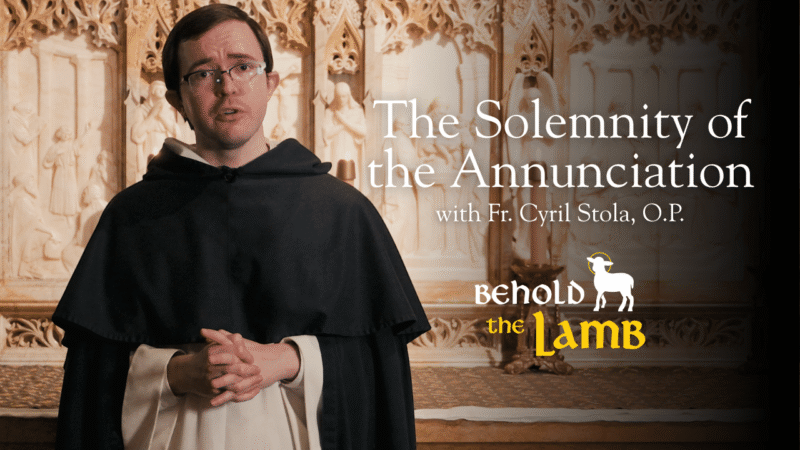


Last month on the Feast of Our Lady of the Rosary, Fr. Patrick Mary Briscoe, O.P. preached the homily at a solemn Mass at the Church of St. Vincent Ferrer, located on the Upper East Side of Manhattan. Fr. Peter Martyr Yungwirth, O.P., the pastor of the parish, then led a procession of the faithful, under police escort, into the heart of Central Park.
Near the aptly named Bethesda Fountain, named after the pool where Jesus healed the paralytic in Jerusalem, the procession prayed the Rrosary in unison. With the whole crowd holding small devotional candles, it was a stirring evening devoted to Our Lady.
Read Fr. Patrick’s entire homily below!
Happy feast day. For many years, this feast was known as the Feast of Our Lady of Victory. And I have to tell you, I’m rather fond of that name for this day, because I like winning.
I’m the sort of uncle that doesn’t let his four-year-old niece cheat when we’re playing Candyland, because I love winning that much. But I don’t want to think about Our Lady of Victory as much today, although we ought certainly to remember the times the Virgin Mother of God has come to the aid of the Christian people and delivered us from countless sorrows. No, tonight, friends, I want us to think about the feast as it’s known now, the Feast of Our Lady of the Rosary, and to think especially of this gift, the Rosary that we’ve been given through the Virgin Mary.
Pope Leo XIII, from whom our pontiff has his name, Pope Leo XIII says, reflecting on Saint Dominic, ‘Our need for divine help is as great today as when the great Dominic introduced the use of the Rosary of Mary as a balm for the wounds of his contemporaries.’ The Rosary of Mary.
Now, you might think it’s a passing connection to explore this image of the Rosary, or really properly the Rose, with this devotion. And you might even find it a little standoffish, especially if you’re a man. Oh boy, Father’s going to talk to us about a flower tonight. That’s right, gentlemen, because this great prayer, the Rosary, is based on a noble flower, the Rose. So first consider the roots. I don’t know about you, but for me, many times in my life, I’ve come to the chapel, to our choir here in St. Vincent Ferrer, to wherever I am, with much to say to God, and it might surprise you, but very few words. I hardly know how to express all the things I’m thinking or feeling that I know I need to pray for. And time and time again, the Rosary has been an aid in my life, keeping me grounded. Just like the Psalms, when we come here to sing them, or all the other parts of the Mass, the great praises of God that we sing, these familiar words ground us, keeping us deeply planted. And the thing about those roots is that they will endure, they will allow you to persevere during great periods of dryness.
At the House of Studies, our Dominican Seminary in Washington, D.C., we have a very lovely garden in the middle, and you might think that it’s very well tended, but it’s not. It’s sort of a shabby thing. And the remarkable thing is that every year, the roses that are planted there produce the most magnificent blooms, despite the horrendous neglect they suffer from the friars. This is because these roses have great roots. They are well-established plants. They can endure even consistent decades of friar neglect, and still produce marvelous flowers. The Rosary in our lives can endure even the indifference and neglect of our hearts. It can hold us fast like a root, binding us to the saving mysteries of Christ, the doctrines that keep us planted. When we’re tempted to think all meaning is lost, when we’re tempted to sway in the wind, to let go, the roots keep us there. Saying the Rosary is enough. It’s enough to connect us to these saving mysteries, to ground us.
Pope Leo XIII says, The Rosary is not only an ever-ready remedy for misfortune, but a whole badge of Christian piety. One of the extraordinary things of life as we know it, of Christian life, is that God allows us to experience such sufferings. And I mean an extraordinary thing because I never would have imagined in my religious life that I would know suffering like I have known it. Because I didn’t know how my heart could be broken as a priest. I didn’t know what it would be like to be locked out of a hospital, unable to get to my parishioners during the Covid pandemic, watching one of my good friends die alone. I didn’t know what that would be like. I didn’t know what it would be like to weep with friends in those moments of loss, to feel it as if it were my own loss. And thank God the Lord didn’t show me, because I don’t know that I could have accepted all of this. And I’m sure that there is some sorrow in your heart too.
Something that the Lord has asked you to bear that you couldn’t have imagined possible, that you didn’t have a place for.
Roses have thorns on their stems. And the thorns of this life are very great. Saint Paul laments the thorn in his flesh. Our Lord bears a crown of thorns in his passion. And yet, as Pope Leo promises, the rosary is an ever ready remedy for misfortune. Because despite all of those things, I don’t know what I would do if I weren’t a Christian. Because the joys of this life are so much sweeter than anything I would have guessed. They’re so much better. The happinesses are just so much greater.
Just recently I was at the Jubilee for Youth. You know, we have a jubilee for everything this year. Pope Leo XIV was elected during the Jubilee for Marching Bands. That was my favorite of the jubilees when Rome was full of marching bands. The Italians loved it. I loved it too. But I was there during the Jubilee for Youth and one of us, I don’t know, it might have even been me, had the great idea that we could walk from Santa Sabina, the mother church of the Dominican Order, that we could walk from Santa Sabina to Tor Vergata where we were going to meet Pope Leo with a million other young people. Now, for those of you following along in your pew, you say, that sounds like it’s quite a distance if it’s a place where a million people are going and you’re correct. It was 14 miles, which looked a lot shorter on Google Maps. I spent that day fairly quiet, especially for me, especially in the mid-afternoon. It was hot. Oh, it was so hot and the walk was long. It was so long. I was miserable and my feet hurt.
And then Pope Leo arrived and the whole place just went completely berserk. It was electric to see the Pope fly around this crowd in a helicopter and then do an hour-long tour in the Popemobile greeting the whole crowd. It was amazing. And then a moment of quiet Eucharistic adoration, a million people, silent, totally silent, kneeling before the Blessed Sacrament. The joys are so much sweeter than I would have imagined. Afterward, we were walking away from Tor Vergata. I was waddling at this point because I could barely move. And I asked one of the men who was with us, his name was Jackson, and he had just been baptized a week ago. One week before he had been baptized and received in the church.
And I said to Jackson, what did you see at Tor Vergata? And he says, I saw hope. This is a young man whose father was addicted to painkillers, who had left his mother when he was in high school, who for years had doubted the existence of God, any meaning, any purpose in his life, who had found it, who was baptized, who sees this whole crowd of people together with the Pope praying in front of the Blessed Sacrament and who says, I saw hope. There are thorns.The rosary is a remedy for our misfortune. And not only that, it is a whole badge of Christian piety. Its fragrance is sweet, friends, our Christian life.
Finally, the flower itself. Pope Leo says the rosary, if rightly considered, will be found to have in itself special virtues, whether for producing and continuing a state of recollection or for touching the conscience, for its healing, or for lifting up the soul. It is impossible for a habit of sin, a deep vice to remain in life when the rosary is prayed diligently and faithfully.
All of the vices and sins we’re tempted to give way to the graces of the rosary, which grow in secret. No one sees a flower opening. We don’t sit around watching, especially now because we all have three and a half second attention spans thanks to TikTok. No one sits around watching for the rose to open. It just suddenly is open one day. Praise works like this in our hearts, opening us up that we might, like a rose, yearn for the heavens, lift the petals of our hearts to God, to praise him, to strain like flowers to heaven, to be open.
Many appearances of the Virgin Mary have connections to roses. Like at Lourdes, my favorite apparition, gold roses appear on the Virgin Mary’s feet. There are roses in the Tilma of Juan Diego when the miraculous image of Our Lady of Guadalupe appears. There are roses at Knock. There are even roses at La Salette, a very sorrowful apparition of the Virgin Mary. She is the mystical rose, the tender stem.
Jesus in the scriptures is viewed as the rose too, the rose of Sharon, the prize flower of the line of David. And we too are roses, roots and thorns and flowers all. Let us pray this night, that bound to this prayer of the Virgin Mary, the Lord might gather us into his arms.
Amen.